Books by Jasper Fforde
Blog entries for:
- (2001) The Eyre Affair.
- (2002) Lost in a Good Book: a Thursday Next novel.
- (2003) The Well of Lost Plots: a Thursday Next novel.
- (2004) Something Rotten.
- (2007) Thursday Next in First Among Sequels.
- (2011) One of Our Thursdays is Missing.
- (2012) The Woman who Died a Lot.
Nursery Crime books:
- (2005) The Big Over Easy .
- (2006) The Fourth Bear: a Nursery Crime.
The Woman who Died a Lot
 The Woman who Died a Lot
(
The Woman who Died a Lot
( 2012)
is one of Jasper Fforde's best.
2012)
is one of Jasper Fforde's best.
As usual, Fforde is a master satirist with a delight in the multi-threaded plot,
so much so that the reader might feel sympathetic to the protagonist, Thursday Next,
when she claims (admittedly when trying to appear aberrant in a psych interview)
(p.32):
|
I've spent most of my life confused ...
You get used to it after a while.
There's a lot to be said about merely having a hazy idea of what's going on but generally
reaching the right outcome by following broad policy outlines.
... Once the horror and unpredictability of unintended consequences gets a hold,
even the best-intentioned and noblest of plans generally descend
to mayhem, confusion, and despair.
|
The book is something of an ode to library — or at least librarian —
power (p. 108):
|
Luckily for the librarian who fired the shot,
the potential thief had fallen within the library boundary,
allowing the killing to be categorized as
"Justifiable Lethal Force by a State-Registered Librarian
in the Course of His or Her Duties," a misdemeanor
that required only a few forms to be filled in.
As it says on the T-shirts, I DON'T SCARE EASILY — I'M A LIBRARIAN.
|
Thursday and her family add to the demonstrable truth that (p.206):
|
wishful thinking and being easily distracted are powerful evolutionary tools.
|
Ffordes' closing thanks are particularly apt — and so is
his page count equaling the number of days in a Leap Year —(p.366):
|
I'd also like to thank the Van Allen belts for protecting us from the harmful
solar wind, and the earth for being just the right distance from the sun to
be conducive to life, and for the ability of water atoms to clump so efficiently,
for pretty much the same reason. Finally, I'd like to thank every single one
of my forebears for surviving long enough in this hostile world to procreate.
Without any one of you, this book would not have been possible.
|
Lastly a mention that the book is about Smiting, Smitees, and Smite-deflectors —
all timely in the modern smite-worthy world.
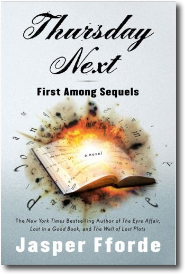
Thursday Next in First Among Sequels
Thursday Next in First Among Sequels
( 2007)
is Jasper Fforde's best yet.
Fforde is a master satirist with the quickest of pens.
In this book, the protagonist is Thursday Next.
The plot concerns saving the world.
The McGuffin is the recipe for unscrambling eggs.
As Michael Berry (San Francisco Chronicle, Sept 30, 2007, p. M2) wrote:
|
I appreciate Fforde's depth of imagination,
his heartfelt defense of the art of reading,
and the cleverness of this series' central conceit.
|
However, we disagree with Berry's dismissal that:
|
There are too many plotlines, and the exposition of how the Bookworld operates
too often slams the brakes on the narrative
... almost every other character [than the protagonist]
exists only to deliver punch lines and clever asides.
... [high] wheat-to-chaff ratio.
|
Concerning Berry's compliant about plotlines, Fforde
has multiple plotlines because they are interesting and relevant (sometimes for the plot, sometimes for social commentary, often for both).
The complexity that daunts Barry seems much more like real life (where one juggles making supper with averting the end-of-the-world,
solving work problems, and mentoring a juvenile) than a stripped-down minimalist plot.
Concerning Berry's compliant about exposition, Fforde
uses as nifty technique to orient the reader quickly to his multilayered world,
where the heading of each chapter is a quotation from another fictional
book. This is especially helpful as his world includes
[page numbers above refer to the hardback USA first edition (2007) and are mostly
from the headings of each chapter: quotations from other fictional books]:
- "normal" middle-class family life in "a central position
in southern England" in a town with
"the only radio station in England dedicated solely to mariachi music" [p. 1].
- The "Special Operations Network ... instituted in 1928 to handle police duties considered ...
too unusual or too specialized to be tacked for by the regular force ... those that dealt with
vampires (SO-17), time travel (SO-12), [and] literary crime (SO-27)" [p. 23]
- "Jurisfiction ... the policing agency within books.
Working with the intelligence-gathering capabilities of Text Grand Central, the Prose Resource
Operatives at Jurisfiction work tirelessly to maintain the continuity
of the narrative within the pages of all the books ever written,
a sometimes thankless task.
Jurisfiction agents live mostly on their wits as they attempt
to reconcile the author's original wishes and the reader's expectations
against a strict and largely pointless set of bureaucratic guidelines laid down by the Council of Genres." [p. 35].
Concerning Berry's compliant about characters, Fforde in fact slips only once:
Isambard Kingdom Bruñel
generates a word vocabulary that has feeble echoes of
Roald Dahl, but ends up sounding stupid. Thankfully this painfulness is caged into Chapter 11.
Meanwhile all the other characters, especially Friday's other selves and her family members,
are necessary and contribute.
We can only praise a Bookworld that has a
Mispeling Vyrus Farst Respons Groop.
And an "Anti-Smite shield, designed to protect mankind (or Britain at the very least)
from an over-zealous deity eager to cleanse the population of sin" [p. 261].
Even more, we admire the book's awareness of the dangers of poetry:
"It's not like the books where everything's laid out and orderly.
The oral tradition is dynamic
like you've no idea.
Change anything in there and you will, quite literally give the narrator
... a brain hemorrhage. The same can be said of
Poetry.
You don't want to go hacking around in there without
a clear head on your shoulders."
"Why?"
"It's like a big emotion magnifier.
All feelings are exacerbated to a dangerous level.
You can find things out about yourself that you never knew--or never
wanted to know.
We have a saying:
'You can lose yourself in a book, but you find yourself in Poetry.'
It's like being able to see yourself when drunk." [p. 49].
|
In a meeting with the Council of Genres, Thursday says: "I
say we place our faith in good stories well told and leave the interactivity
as the transient Outlander fad that it is. Instead of being subservient to
reader opinion, we should be leading it."
Yes, indeedy, even if that lands you where:
|
"Rescue seemed a very remote possibility,
and that was at the nub of the whole ethical-dilemma argument.
You never come out on top no matter what.
The only way to win the game is not to play." [p. 303].
|
But how does it turn out? Read the Book!
The Fourth Bear: a Nursery Crime
The Fourth Bear: a Nursery Crime
(2006) by Jasper Fforde.
Really good, especially for those of us that have run out of Douglas Adams and Terry Pratchett.
A fantasy plot that writhes and ripples and reinvents itself in each chapter.
Punch and Judy (of the Show) as marriage counselors are particularly effective.
Many jokes on most pages. One laugh-out-loud joke occurs when, trying to determine some
background on the large unexplained explosion in the Berkshire village of Obscurity,
Detective Chief Inspector Jack Spratt, quizzing the local vicar, comments on the large size of the church graveyard.
The vicar responds, naturally:
|
You'd be surprised by the number of people who die in Obscurity.
|
Another, with an insight almost as verbal as that of
George W. Bush,
is Jack's realization that a 50-kilogram cucumber is a critical-mass
ultimate weapon:
|
"McGuffin, flitting around with his Men in Green,
in the background, was changing, crossbreeding, bioengineering
and reseeding until he had created a devastatingly destructive power that could be
created in a grow bag with nothing more complex than a dibbler
and a watering can."
"You mean . . . ?"
"Right," growled Jack. "Cuclear energy."
|
And then there is the admission that the Gingerbreadman:
|
is the prototype of Project Ginja Assassin,
a bioculinary weapons technology ...
impervious to pity, guilt or scruples,
as the advance guard of an army on the move
... agile, adaptable, tireless and highly motivated -- the perfect Ginja.
|
This one almost reaches the brilliance of his Thursday Next books.


 The Mental Health of George W. Bush