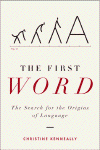
The First Word: The Search for the Origins of Language
by Christine Kenneally
Language and Linguistics books
Chapters of The First Word: The Search for the Origins of Language
A fascinating and readable popularizing book
by linguist Christine Kenneally.
Part 1: Language is not a thing.
Traces the historical arc of interest in the origins of language and language evolution,
culminating with four recent
"figures that bear much of the responsibility for the current state of the art"
in the study of language evolution.
Chapters:
- Noam Chomsky:
|
Chomsky's signature claim is that all humans share a 'universal grammar,'
... a set of rules that can generate the syntax of every human language.
... Traditional researchers committed to Chomskyan linguistics believed
that universal grammar exists in some part of our brain in a language organ
that all humans possess but no other animals have. [p.25]
|
His view was that
"language is a uniquely human phenomenon, distinct from the
adaptations of all other organisms on the planet ... Not only does language differentiate us
from all other animal life; it also exists separate from other cognitive abilities like memory,
perception, and even the act of speech itself. Researchers in this tradition
have searched for
... a part of the brain devoted solely to linguistic skills
... [and for] the roots of language in the fine grain of the human genome,
maintaining, in some cases, that certain genes may exist for the soul purpose of encoding grammar." [p.9]
The Chomskyan view dominated from the mid-20th century till 1990s.
|
Chomsky's legend
... stifled language evolution research during the latter half of the twentieth century. [p.39]
|
- Sue Savage-Rambaugh "has taught a nonhuman [the ape Kanzi] how to use language" [p.8]
and views language as
"interdependent and interconnected with other human abilities and other cognitive tasks" [p.9].
Since the 1990s, this view has led many linguists to move away from hard-core Chomskyanism.
- Steven Pinker (Harvard cognitive scientist and popularizing author) and Paul Bloom:
"All we argue is that language is no different from other complex abilities, such as echolocation
... and that they only way to explain the origin of such abilities
is through the theory of natural selection" [p.57].
- Philip Lieberman (Brown University, though originally at MIT under Chomsky).
in his 1984 The Biology and Evolution of Language
he was one of the first to oppose the Chomskyan view, by his argument that:
|
no single dramatic event gave birth to human language.
The Chomskyan idea of an ideal speaker and hearer confused the origins of language. [p.72]
|
Part 2: If you Have Human Language ...
This Part is full of experimental results,
exploring how "the language suite
—
what abilities you have if you have human language" [p. 10]
evolved.
Chapters:
- You have something to talk about. See [p.108] Lupyan's experiment with teaching people
which aliens were 'friendly' and 'unfriendly' and how the addition of a word to label each type of alien
led to:
'The group that had words to label them learned to distinguish them much faster than the non-word group.
He [Lupyan] concluded that language, specifically the act of naming something with a word,
helps categorize.'
- You have words. See [p.116] Chris Code's point:
'That it is possible neurobiologically to separate swearwords from other words in language.
Swearing actually uses parts of the brain that support language
and also parts of the brain that are used when laughing and crying.
Often people with severe brain damage remain able to swear
even when they are unable to produce other language.'
- You have gestures. See [p.124]:
'Most primates, humans included, gesture communicatively with their right hands,
suggesting that the dominance of one side of the brain for vocal and gestural communication
could be as old a thirty million years.
Just as with humans, ape gestures can involve touch, noise, and vision.'
Also see [p.129] Kenneally's interpretation of Tomasello that:
'What we have evolved into now is a species for whom an experience means little if it's not shared.'
Sue Savage-Rumbaugh's observed two apes that had some use of sign language engage in
a sign-shouting match; neither ape was willing to listen.
Language, wrote Savage-Rambaugh,
"coordinates behaviors between individuals by a complex process of exchanging behaviors that are punctuated
by speech."
At its most fundamental,
language is an act of shared attention,
and without the fundamentally human willingness to listen to what another person is saying,
language would not work.
|
- You have speech. See [p.143]: In the 1940s, linguist George Zipf
|
got his graduate students to count how often particular letters appeared in different texts, like Ulysses,
and plotted the frequency of each letter in descending order on a log scale. He found the slope he had plotted
had a -1 gradient ... [and] that most human languages, whether written or spoken,
had approximately the same slope of -1. Zipf also established that completely disordered sets of symbols
produced a slope of 0 ... all elements occurred more or less equally.
Zipf applied the tool to babies' babbling, and the resulting slope was closer to the horizontal.
|
When Doyle and McCowan applied Zipf's law to the sounds of dolphins and plotted sound frequency:
|
they discovered that, like human language, it [their graph] had a slope of -1.
A dolphin's signal ... had structure and complexity.
... [Furthermore] signals produced by squirrel monkeys ... [have a slope of] -0.6, suggesting that they have
a less complex form of vocalization.
|
Also see the application of entropy to information as [p.143-4]:
|
developed by Claude Shannon, who ... [calculated] how much information was actually passing through a given phone wire.
Entropy can be measured regardless of what is being communicated because instead of gauging meaning,
it computes the information content of a signal.
The more complex a signal is, the more information it can carry.
Entropy can indicate the complexity of a signal like speech or whistling,
even if the person measuring the signal doesn't know what it means.
... SETI plans to use entropy to evaluate signals from outer space
... to give us an idea about the intelligence of the beings that transmitted the signal
even if we can't decode the message itself.
... Human languages are approximately ninth-order entropy,
which means that if you had a nine-word (or shorter) sequence from, say, English,
you would have a chance of guessing what might come next.
If the sequence is ten words or more, you'll have no chance of guessing the next word correctly.
The simplest forms of communication have first-order entropy.
Squirrel monkeys have second or third-order, and dolphins measure higher, around fourth-order.
|
- You have structure. See [p.164]: the approach of Chomskyists like Mark Baker who
'deduced a hierarchical list of fourteen parameters that he believes reflect rules that are hardwired into the human brain.
He thinks there may be about thirty rules overall.'
In contrast,
|
Jackendoff call this kind of approach "syntactocentric," meaning that syntax is regarded
as the fundamental element of language.
In contrast, he says, "in a number of different quarters,
another approach has been emerging in distinction to Chomsky's," In this new way of
accounting for structure in language, words and phrases are as important as the rules that combine them,
and the idea of pure syntax is downplayed.
... Rather than thinking of syntax as a set of computational algorithms, Jackendorf and Pinker call it a
"sophisticated accounting system"
for tracking the various layers of relationship and meaning
that can be encoded in speech and then decoded by a listener.
|
- You have a human brain.
The brain is very plastic, with parts of the brain taking over for parts that are removed.
One of its hemispheres can be removed (in a 'hemisperectomy') to avoid seizures.
In the case of at least one 9-year-old, a first spoken language was aquired after such surgery.
Also discusses mirror neurons and the importance of the cerebellum in coordination of movement and language.
- Your genes have human mutations. As on p.202:
|
Language is constituted of an aggregate of different traits and processes
that have developed over time.
There was no one moment at which humans became definably human,
just as language did not appear suddenly from the ether.
... In the end, you have to be human to have human language.
... Humans won't speak or produce language unless they are taught to do so,
which means that our remarkable capacity doesn't amount to much at all if someone
isn't there to provide a model for how to use it.
|
Part 3: What Evolves?
How did the language of our parents get here in the first place?
Includes computer modeling by Kirby and Christiansen
viewing language
"as a virus, one that grows and evolves symbiotically with human beings
... language shifts around and adapts itself in order to develop and survive" [p.11]
Chapters:
- Species evolve
|
When did language begin? Its foundation can be traced back to our common ancestor with
primordial lizards.
Yet what we recognize as language today took shape sometime in the last six
million years.
It's clear just from the distribution of elements of the language suite
over different animal species and throughout the lineage of the human species
that language did not evolve overnight, turning us from animals into people.
The mere fact that different traits are shared with different animals suggests that
language come together in bits and pieces, step by step.
... How old is gesture?
At least as old as our shared ancestor with other great apes.
How old is simple syntax?
Perhaps as old as our common ancestor with monkeys,
which lived forty-five million years ago.
... When you look at how these pieces evolved,
you can start to narrow down why they evolved.
|
- Culture evolves
- Why things evolve
Part 4: Where Next?
Chapters:
- The future of the debate
- The future of language and evolution
Concludes with:
A terrific book for thoughtful students of language.
 [Thanks for visiting.]
 Disclaimer
 Books read recently.